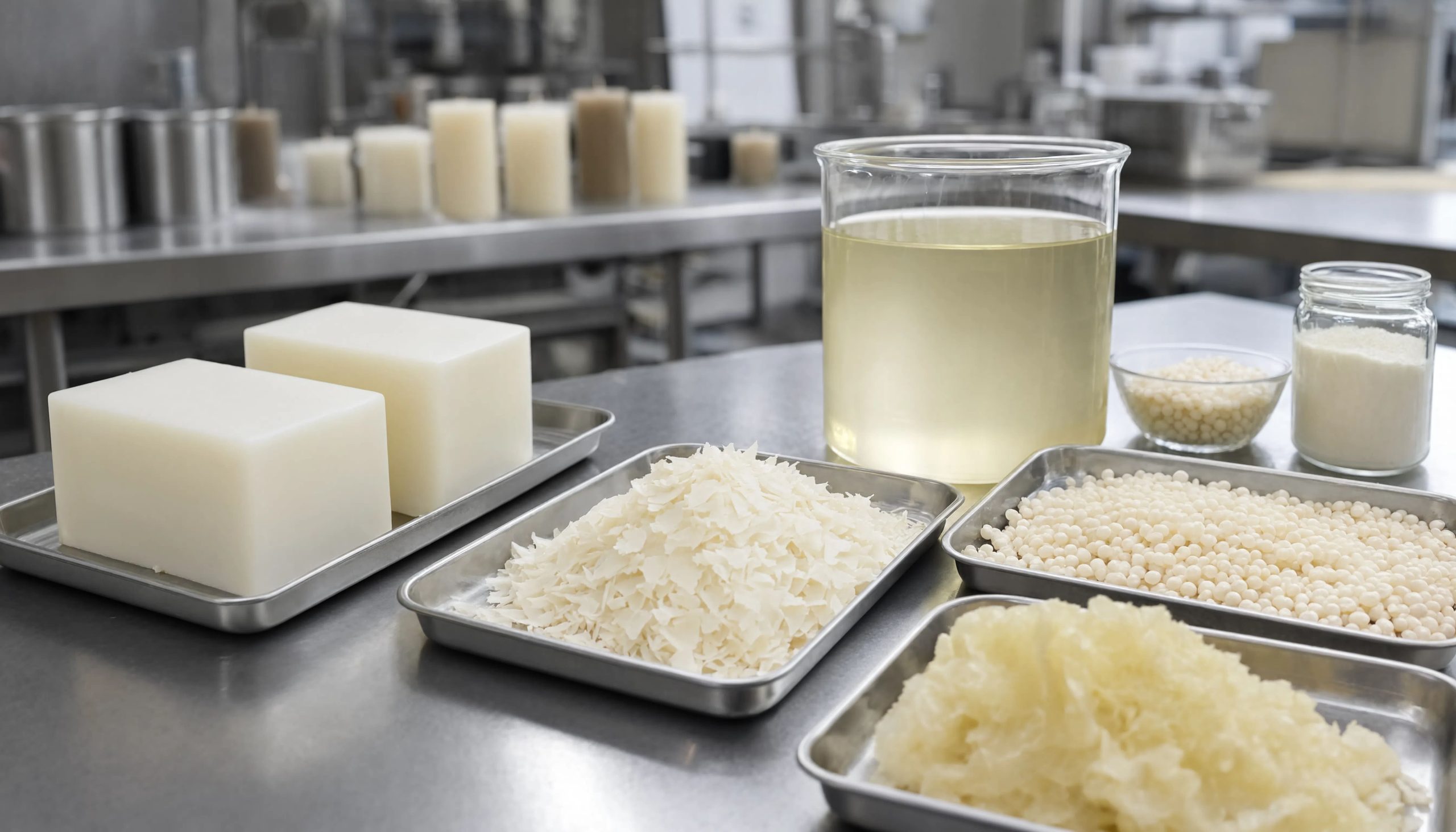
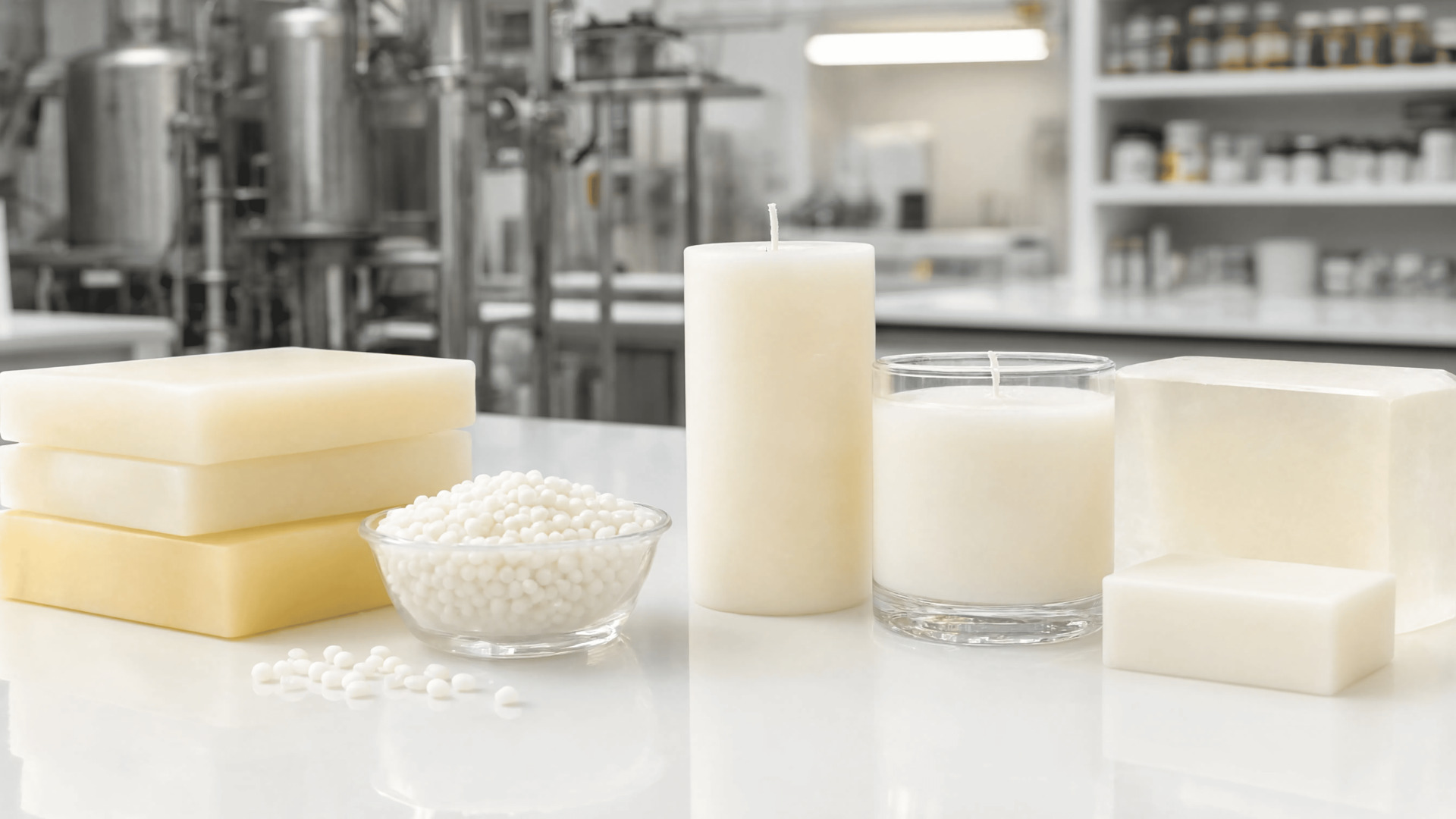
Paraffin wax is one of the most widely used raw materials in candle manufacturing due to its versatility, stability, and ability to adapt to different formulations and production processes.
However, there is no single type of paraffin wax suitable for every candle manufacturing application. Melting point, degree of refinement, hardness, shrinkage, and compatibility with fragrances, pigments, wicks, and other waxes can all affect both the production process and the final result.
For this reason, for an industrial manufacturer, the choice should be based on thetype of candle, the formulation, and the actual production conditions, rather than solely on price or a single value from the technical data sheet.
Proquinat works with different industrial paraffin waxes for technical applications, including candle manufacturing.
What type of paraffin wax is used to make candles?
The most suitable paraffin wax depends on the type of candle and the properties required. Different grades of refined or semi-refined paraffin wax can be used, provided that their specifications are suitable for the process and are validated in the final formulation.
Two apparently similar paraffin waxes may differ in:
- Melting range.
- Degree of refinement.
- Oil content.
- Hardness or penetration.
- Shrinkage.
- Behaviour during cooling.
- Compatibility with other components.
Therefore, the question should not simply be which paraffin wax is used to make candles, but rather which grade provides the performance required for that specific candle.
What properties should be reviewed when choosing a paraffin wax for candles?
The main parameters are the melting point, degree of refinement, hardness, shrinkage, and compatibility with the rest of the formulation.
It is also advisable to assess cooling behaviour, surface finish, and batch-to-batch consistency when working with recurring production runs.
The technical data sheet helps with the initial selection, but it does not replace testing under actual manufacturing conditions.
How does the melting point affect a candle?
The melting point or melting range influences both the processing temperature and the behaviour of the paraffin wax during cooling and subsequent use.
There is no single melting point that is universally better for candle manufacturing.
Among the refined and hydrogenated paraffin waxes supplied by Proquinat, there are grades with typical melting ranges between 48 °C and 66 °C.
The choice will depend on the type of candle, the manufacturing process, and the desired final properties.
In addition, two grades with similar melting points may behave differently if other parameters vary, such as hardness, oil content, or wax structure.
Refined or semi-refined paraffin wax for candle manufacturing?
There is no option that is always better. The choice depends on the specifications required for the final product.
Refined and hydrogenated paraffin waxeshave a higher degree of refinement and may be suitable when more tightly controlled specifications are required in terms of colour, odour, oil content, or technical performance.
Semi-refined paraffin waxes have different characteristics and may be suitable for certain industrial applications when their specifications are compatible with the product.
The decision should always be based on the specific grade rather than solely on the commercial category.
How does paraffin wax affect the finish and shrinkage of a candle?
Paraffin wax directly influences behaviour during solidification and can affect hardness, shrinkage, texture, and surface finish.
This is particularly important when a consistent appearance needs to be maintained in industrial production.
Its behaviour may also vary depending on the candle format. A moulded candle and a candle produced directly in a container do not necessarily require the same formulation.
For this reason, testing should replicate the actual production process and assess the final result once the candle has cooled completely.
Which paraffin wax should be chosen for each type of candle?
The type of candle should be defined before selecting the paraffin wax, as this determines the performance required from the formulation.
What should be considered for a moulded candle?
Shrinkage, hardness, demoulding, behaviour during cooling, and the final finish are particularly relevant factors.
What should be considered for a container candle?
It is important to control solidification, texture, finish, and the stability of the formulation within the container itself.
What should be considered for a scented candle?
Compatibility between the paraffin wax and the fragrance should form part of the validation process.
Fragrance load, wick, additives, and the manufacturing process can also affect the final result, so the paraffin wax should not be assessed in isolation.
Proquinat also supplies candle fragrances for this type of formulation.
Can paraffin wax be blended with other waxes?
Yes. Paraffin wax can be used on its own or blended with other waxes to modify specific properties of the formulation.
For example, microcrystalline waxes are more plastic and flexible and can be used when the aim is to modify the cohesion or flexibility of the blend.
Vegetable waxes can also be used in formulations where different technical characteristics or a different raw material origin are required.
However, a blend should not be treated as a universal formula. Any modification must be validated within the complete candle formulation.
Is paraffin wax or vegetable wax better for candle manufacturing?
There is no universal answer. Paraffin wax and vegetable waxes offer different characteristics and are suited to different processes and objectives.
Paraffin wax is a well-established solution in industrial production due to its versatility and stability.
Vegetable waxes may be of interest when the formulation or product positioning requires a raw material of plant origin.
The best option will be the one that meets the requirements of the final product while maintaining stable performance throughout the manufacturing process.
How should a new paraffin wax for candles be qualified?
The qualification process should begin by defining what needs to be improved or changed compared with the current grade.
From there, it is advisable to:
- Compare the critical parameters in the technical data sheets.
- Carry out tests using the complete formulation.
- Keep the wick, fragrance, pigments, and additives constant during the comparison.
- Replicate the actual manufacturing temperatures and process conditions.
- Evaluate the finish, shrinkage, hardness, and performance of the finished product.
- Check repeatability before scaling up production.
A new paraffin wax should not be approved solely because it has a melting point similar to the product previously used.
What information should a manufacturer provide to the supplier?
The more technical information provided from the outset, the easier it will be to reduce the number of grades that need to be tested.
It is advisable to specify:
- Type of candle.
- Grade currently used, if applicable.
- Manufacturing process and temperatures.
- Property to be improved.
- Fragrances, pigments, or other relevant components.
- Technical or documentation requirements.
- Approximate consumption volume.
- Destination country or market.
This information helps guide the selection towards the grades most likely to meet the required specifications.
Where can you buy paraffin wax for candles wholesale?
An industrial manufacturer should consider more than just the price per kilogram. Specifications, batch-to-batch consistency, documentation, availability, and continuity of supply are also important factors.
Proquinat has been manufacturing and distributing waxes and paraffin waxes for industrial applications since 1995 and works with companies in the candle manufacturing sector.
Its range includes different families of paraffin waxes and other raw materials, allowing the selection to be adapted to the type of candle, the production process, and the technical requirements.
For industrial production, it may also be useful to explore the different applications of waxes and paraffin waxes available.
Frequently asked questions about paraffin waxes for candles
What is the best paraffin wax for making candles?
There is no single paraffin wax suitable for all types of candles. The right choice depends on the candle format, melting point, hardness, shrinkage, formulation components, and production conditions.
What melting point should paraffin wax for candles have?
It depends on the type of candle and the manufacturing process. The melting point is an important criterion, but it should be assessed together with hardness, composition, shrinkage, and compatibility.
Can I replace one paraffin wax with another that has the same melting point?
It is not advisable to do so without testing. Two products with similar melting ranges may still differ enough to affect the manufacturing process or the final result.
Can paraffin wax be blended with vegetable wax?
Yes, provided that the formulation is compatible and validated through testing before being scaled up to production.
Proquinat: Paraffin Waxes for Candle Manufacturers
At Proquinat, we have been working with waxes and paraffin waxes for industrial applications since 1995, including the candle manufacturing sector.
Our goal is to help select a grade that is suited to the type of candle, the formulation, the production process, and the technical requirements of each manufacturer.
If you need to qualify a new paraffin wax, develop a formulation, or find an alternative to your current grade, let us know what type of candle you manufacture, your process conditions, and your approximate consumption volume.