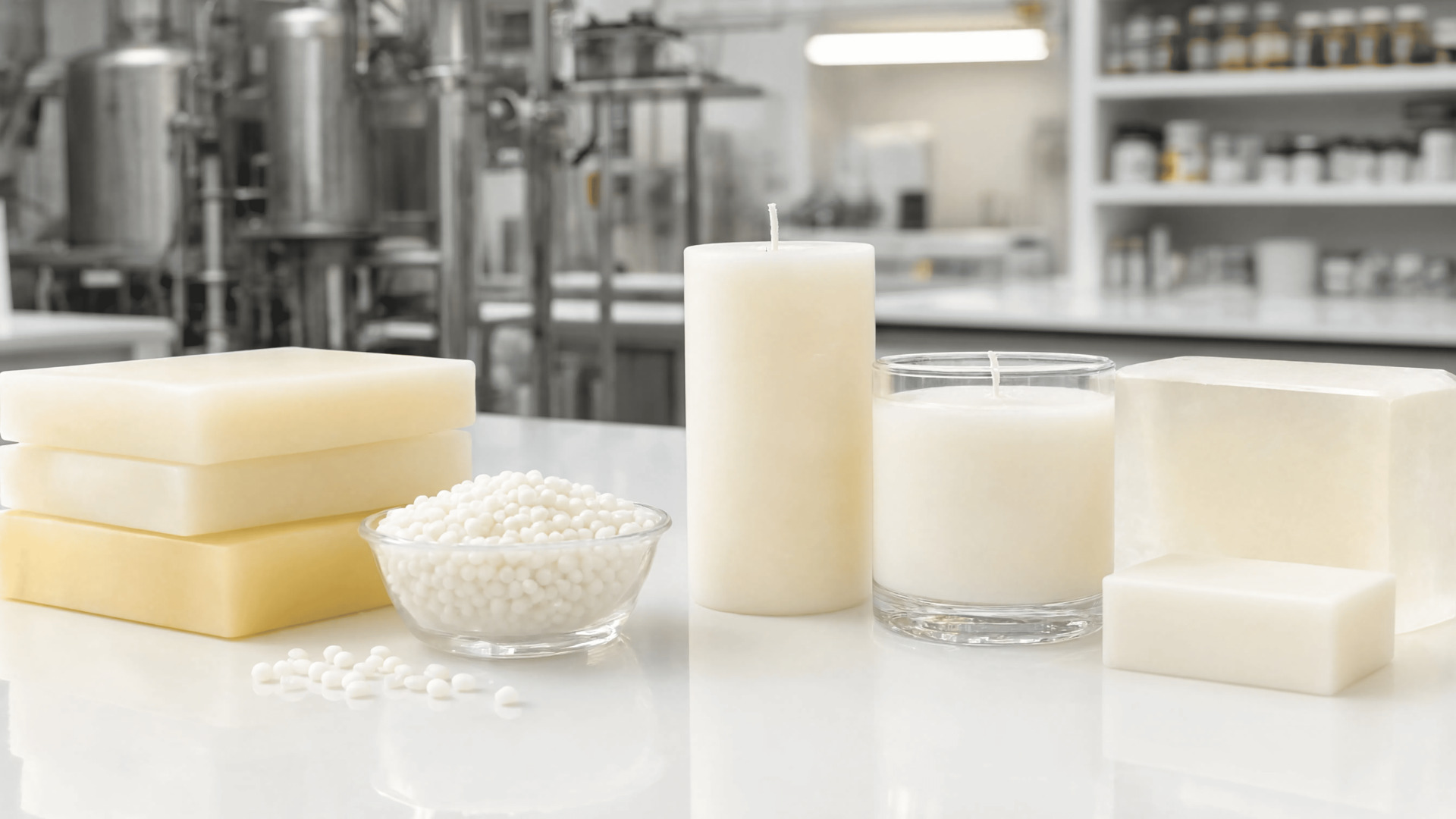
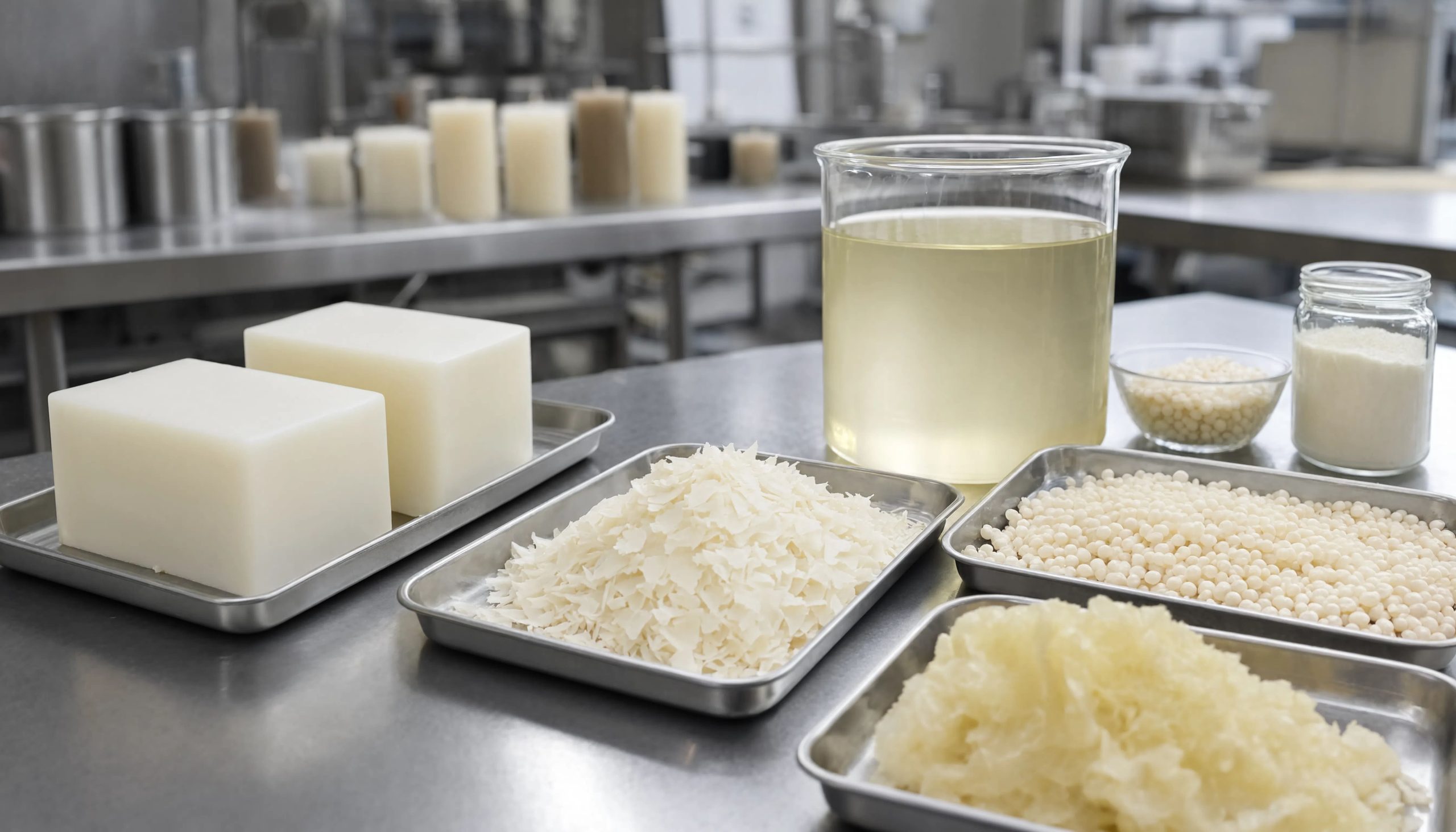
Choosing a wax for industrial candle production involves more than simply comparing its origin or price. The raw material directly affects pouring, cooling, shrinkage, surface finish, thermal stability, and compatibility with fragrances and colourants. Its performance can also vary significantly depending on whether it is used for container candles, moulded candles, or other formats.
Proquinat supplies a range of waxes and paraffin waxes for candle manufacturing, including refined paraffin wax, soy wax, palm wax, coconut wax, rapeseed wax, and beeswax. Depending on the desired performance of the finished product, the formulation may also include complementary raw materials such as stearic acid.
Why does the candle format affect the choice of wax?
A container candle may require good adhesion to the vessel and a consistency suited to that format. A moulded candle needs to retain its shape and withstand demoulding. Other products may prioritise hardness, finish, or decorative performance. The end application defines the technical requirements.
How important is the melting point?
The melting range affects processing temperature, energy consumption, and the product’s stability when exposed to ambient heat. However, it should not be assessed in isolation: crystallisation and the way the blend behaves during cooling are also important
How do you choose between paraffin wax and vegetable waxes?
The choice of wax directly affects factors such as the appearance of the candle, hardness, adhesion to the container, fragrance release, and burning performance.
Paraffin waxes offer a high degree of formulation flexibility, with different melting points, hardness levels, and characteristics available depending on the type of candle and manufacturing process. This makes them suitable for container candles, pillar candles, votives, and other applications.
Vegetable waxes, such as soy, rapeseed, coconut, or palm wax, make it possible to develop formulations using renewable raw materials. Each has its own characteristics in terms of hardness, texture, crystallisation, and finish, offering greater formulation flexibility depending on the type of candle and the desired result.
Paraffin wax and vegetable waxes do not necessarily have to be used separately. Wax blends make it possible to combine different properties and tailor the formulation to specific performance, aesthetic, and manufacturing requirements.
For this reason, the choice should be based on the desired performance of the finished candle, while also taking into account the fragrance, wick, container, additives, and processing conditions.
What should be validated when a candle contains fragrance?
Fragrance is part of the overall formulation and can affect pouring, solidification, and burning performance. It is advisable to use professional candle fragrances and validate compatibility, dosage, and stability together with the selected wax.
What production issues can indicate that the wrong wax has been selected
Excessive shrinkage, uneven surfaces, cracks, colour variations, inconsistent demoulding, or cooling times that do not fit the production line may indicate that the wax or formulation needs to be adjusted. Variations between raw material batches should also be monitored.
How should a wax be qualified for ongoing production?
The qualification protocol should replicate the actual production process and compare working temperature, cycle time, appearance, stability, and finished-product performance. For high-volume manufacturers, it is also essential to ensure continuity of supply and consistent specifications.
What information should you share with the supplier?
To help select the right wax or paraffin wax, it is best to provide clear information about the application and production process from the outset.
The most useful information is:
- Type of candle being manufactured.
- Wax or paraffin wax currently used, if applicable.
- Manufacturing process and temperatures.
- Candle format: container, moulded, or other.
- Property to be improved or issue to be resolved.
- Fragrances, pigments, wicks, additives, or other waxes used in the formulation.
- Required supply format.
- Approximate consumption volume.
- Specific technical or documentation requirements.
The more specific the information provided, the easier it is to preselect the most suitable wax family, reduce unnecessary testing, and focus trials on grades that are more likely to meet the requirements.
The goal is not to find “the best wax” in absolute terms, but the one that provides the best balance between technical performance, production stability, availability, and real cost in use.